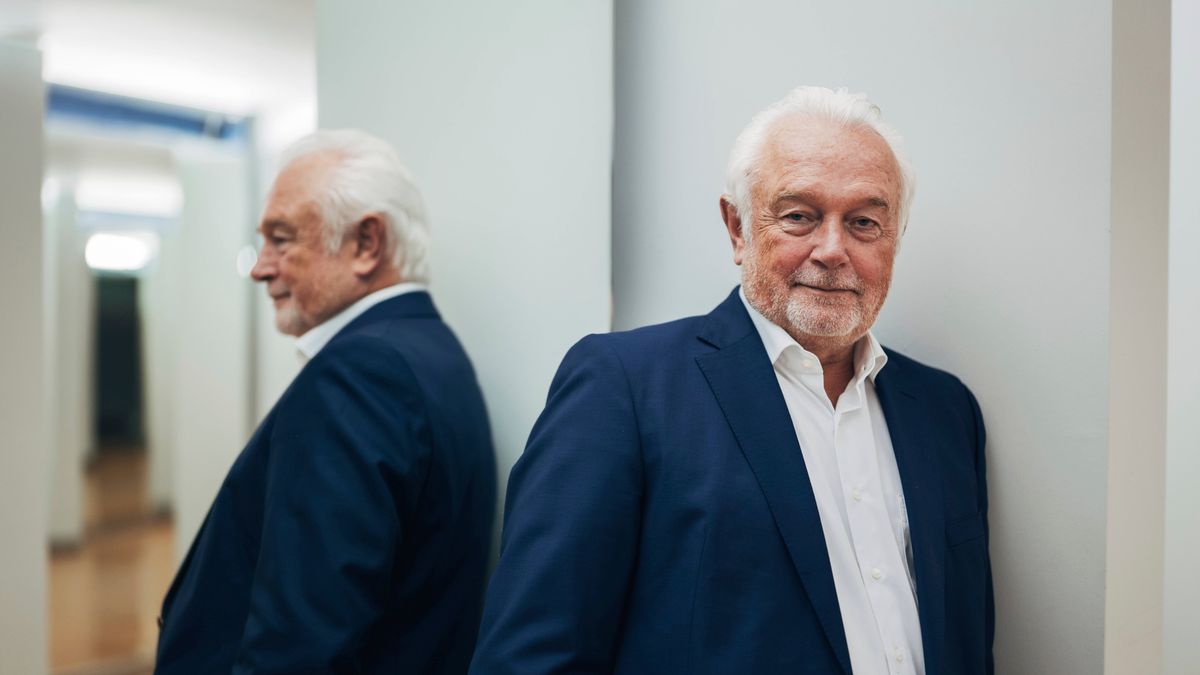
Wolfgang Kubicki Unleashes Sharp Critique on Scholz & Habeck's Policies Amidst Coalition Tensions
In a political landscape often characterized by careful diplomacy, Wolfgang Kubicki, the outspoken Vice-Chairman of the FDP and Vice-President of the German Bundestag, has once again cut through the noise with a fiercely critical assessment of Germany's current leadership. His recent interview with Clemens Traub for the Cicero Podcast Politik laid bare his profound dissatisfaction with Chancellor Olaf Scholz and Economic Minister Robert Habeck, questioning their competence, policies, and the very direction of the governing coalition. For those interested in the robust and often provocative insights of experienced German politicians, and perhaps searching for a distinct voice like "Wolfgang Kubicki Jung" in the political discourse, Kubicki's latest statements offer a compelling and unvarnished perspective on the nation's challenges.
Kubicki's candid remarks underscore a growing tension within the traffic light coalition, highlighting fundamental disagreements that threaten its longevity. His willingness to openly challenge the status quo, even at the risk of internal party friction, demonstrates a deep-seated conviction that Germany needs a significant course correction.
The FDP's Ultimatum and Kubicki's Personal Stand
Kubicki’s recent statements are not a sudden outburst but rather the culmination of long-standing concerns within the FDP regarding the direction of economic and migration policies. He asserts that the FDP has always communicated its position transparently, and his own declarations since mid-June have been unequivocal: if a shared foundation for reforming economic and migration policies cannot be re-established, the coalition cannot continue.
"I can certainly say that I don't need a paper from the business office to have strategic considerations," Kubicki declared, dismissing any surprise regarding his frankness. He emphasized his personal drive behind these demands, stating, "I wanted out of this coalition, I no longer wanted to support a Chancellor who puffs out his cheeks but gets nothing done." This visceral rejection of perceived inaction and unmet promises forms the core of his critique against Chancellor Scholz.
Kubicki’s readiness to take personal responsibility for his stance is striking. "And if you need a culprit, take me," he challenged, signalling his unwavering commitment to his convictions, even if it means bearing the brunt of criticism. This stance highlights a principled approach, where political expediency is secondary to what he believes is essential for the country's welfare. His commitment to practical governance over mere rhetoric resonates deeply with a public yearning for tangible solutions to pressing issues.
Scholz's "Wumms" Promises: A Critique of Unfulfilled Ambition
Chancellor Olaf Scholz's tenure has been marked by repeated pledges of "Wumms" – a German term implying a forceful impact or boost, particularly in the economic realm. From a "Doppel-Wumms" to a "Dreifach-Wumms," these grand pronouncements were meant to signal decisive action and confidence. However, Kubicki brutally dismisses these promises as hollow, arguing that they have amounted to nothing more than "gentle breezes" (
laue Lüftchen).
Kubicki's scathing assessment portrays Scholz as a "Gernegroß" – a braggart who announces much but delivers little. "I can't even list them all," he quips about the endless "Wumms" promises. "And of all those Wümmsen, nothing is left but lukewarm breezes." This critique is not just rhetorical; it reflects a deep concern over Germany's economic performance and the perceived lack of effective leadership in tackling inflation, energy crises, and industrial stagnation. Kubicki, a trained economist, views these failures not just as policy missteps but as a fundamental inability to translate ambition into tangible results, directly impacting the livelihood of German citizens. He and the FDP have consistently demanded a shift towards growth-oriented policies, tax relief for businesses, and a reduction in bureaucratic hurdles to truly inject the promised "Wumms" into the economy. For more on the FDP's demands amidst these challenges, explore
Wolfgang Kubicki: FDP Demands Change Amid Coalition Crisis.
Habeck's Competence and "Bubble" Campaign Under Fire
Perhaps the most visceral of Kubicki's criticisms is directed at Robert Habeck, the Minister for Economic Affairs and Climate Action. As an economist himself, Kubicki minces no words in questioning Habeck's fundamental understanding of economic principles. His infamous remark that Habeck has effectively completed "three years of tax-financed internship" without truly grasping how the economy works is a devastating indictment of his competence.
Beyond competence, Kubicki lambastes Habeck's communication style and political strategy, particularly his election campaign. He describes it as a "bubble campaign," designed solely to appeal to his own voter base, rather than engaging with the broader electorate. Kubicki labels it as "partially kitschy, ridiculous," pointing to campaign slogans that he finds detached from the serious demands of federal leadership. He specifically cites a post proclaiming Habeck as a unifier "for young and old, for black and brown, for blond and back and forth," concluding sarcastically, "Now just 'Amen'." This critique underscores Kubicki’s belief that Habeck's approach is overly moralistic and lacks the pragmatism required for effective governance.
Germany's Fading International Standing
Beyond domestic policy, Kubicki expresses profound concern over Germany's declining reputation on the international stage. He laments that Germany has "never been as unpopular in Europe and the world as it is currently, because we explain to everyone how they should conduct politics." This "moralistic attitude," he argues, has alienated allies and eroded friendships.
Kubicki fondly recalls a time when Germany, under leaders like Hans-Dietrich Genscher, Helmut Kohl, and Gerhard Schröder, was "surrounded by stateswomen and statesmen with whom one enjoyed meeting." He contrasts this with the present, declaring, "I don't know anyone anymore who enjoys meeting Olaf Scholz." This harsh assessment points to a perceived deficit in diplomatic finesse and genuine alliance-building under the current leadership. Germany's preachy stance, particularly on climate and human rights issues, without sufficiently considering the economic and geopolitical realities of other nations, has contributed to this isolation. This aspect of his critique, particularly how Germany is perceived globally, has significant implications for its long-term relationships and influence, an area where
Germany's Stance: Kubicki on Unpopularity and Election Views provides further insights.
The Call for Pragmatism Over Morality: Handwerker, Not Pastors
A recurring theme in Kubicki's critique is the urgent need for pragmatism and hands-on problem-solving in politics. He argues passionately that the German people "don't need moralists; they need craftsmen who tackle problems and make things better." This distinction between "moralists" and "Handwerker" (craftsmen) is central to his political philosophy.
Kubicki believes that the current government, particularly figures like Habeck, often operates from a position of moral superiority, dictating how others should live or govern, rather than focusing on the practical implementation of effective policies. "The people don't want to elect a pastor," he states, highlighting his conviction that leadership should be about tangible results, not just virtuous intentions. This perspective resonates with many who feel that abstract ideals are trumping concrete solutions to everyday challenges facing businesses and citizens alike. He advocates for a return to a politics focused on economic stability, energy security, and controlled migration, executed by competent individuals who understand the mechanics of their portfolios.
Analysis and Implications for German Politics
Wolfgang Kubicki's forthright criticisms are not just personal grievances; they are a strategic move that significantly shapes the political discourse ahead of upcoming elections. His willingness to challenge his own coalition partners so openly signals deep divisions within the government and serves to position the FDP as the party of economic common sense and pragmatic governance.
*
Coalition Instability: Kubicki's statements intensify pressure on Scholz and Habeck, potentially forcing policy shifts or, if unresolved, hastening the coalition's demise. The FDP faces the challenge of differentiating itself within the government while still being part of it.
*
Economic Policy Debate: By highlighting the "Wumms" failures and Habeck's perceived incompetence, Kubicki keeps economic policy at the forefront of public debate, pushing for liberal, growth-oriented solutions that are central to the FDP's platform.
*
Public Mood: His appeal for "Handwerker" over "moralists" taps into a widespread public sentiment of frustration with perceived political grandstanding and a desire for practical, effective leadership that improves daily life.
*
FDP Positioning: For the FDP, Kubicki's strong voice helps solidify its identity as a critical corrective force within the government, potentially attracting voters who are disillusioned with both the SPD and the Greens.
Kubicki's commentary also implicitly touches on the perceived "Jung" (younger/newer) political approaches he criticizes, advocating for a return to proven, results-driven governance rather than what he sees as untested or ideologically driven policies.
Conclusion
Wolfgang Kubicki's sharp critique of Olaf Scholz and Robert Habeck serves as a powerful reminder of the fundamental tensions within Germany's governing coalition. His unvarnished assessment challenges the core competence and policy direction of key ministers, highlighting what he perceives as a failure to deliver tangible results, a decline in Germany's international standing, and a misguided focus on moralistic posturing over pragmatic problem-solving. As Germany grapples with complex economic and geopolitical challenges, Kubicki’s call for "craftsmen" who can tackle problems directly resonates with a public eager for effective leadership. His outspoken stance not only reflects deep personal conviction but also strategically positions the FDP in an increasingly polarized political landscape, potentially influencing the future trajectory of German politics.